


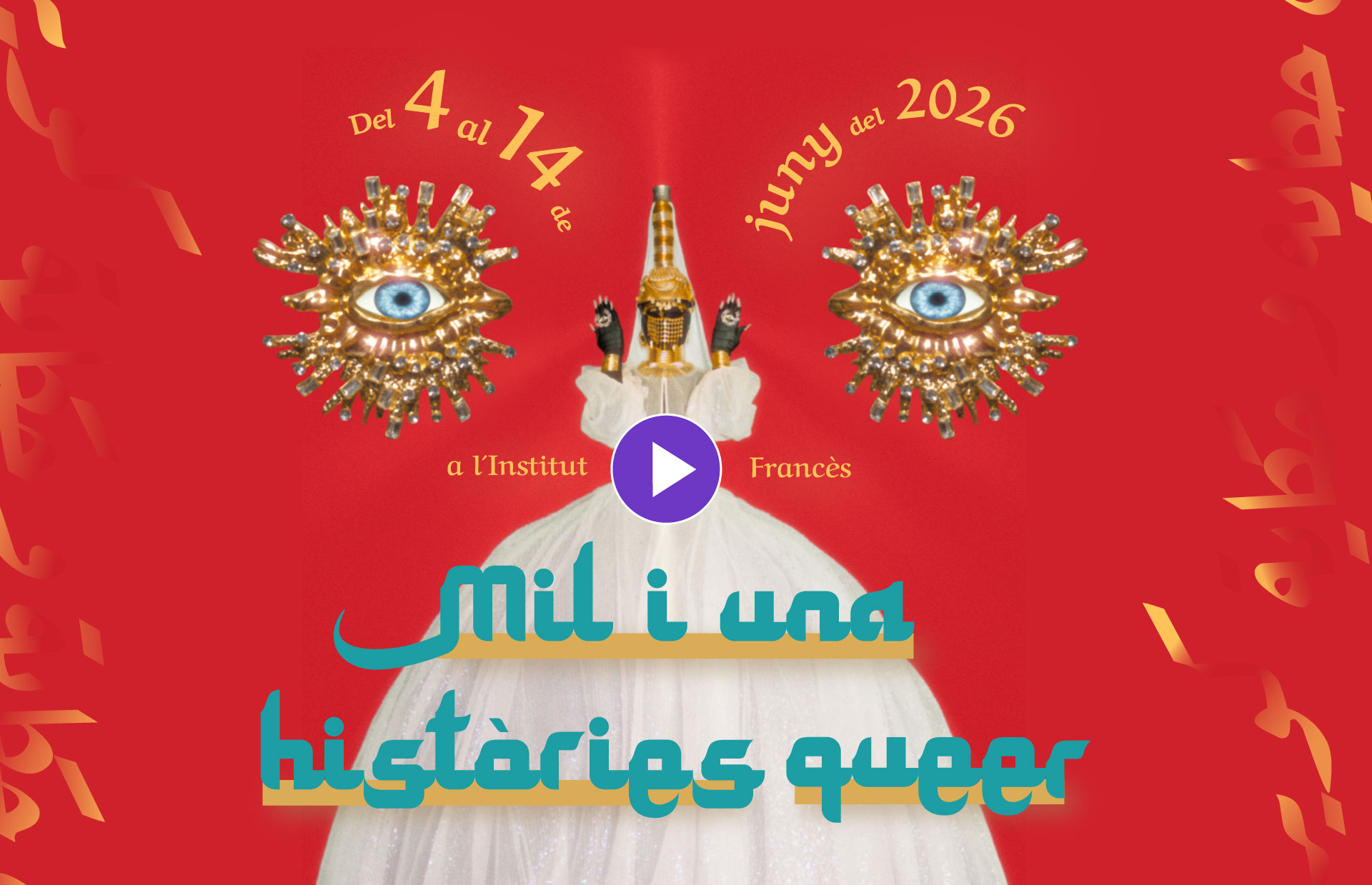


Presentation of the 2026 edition
One Thousand and One Queer Stories
We were far from imagining—when we decided a year ago to dedicate our “The Gaze of…” section to Arab and Persian queer cinema—that geopolitical events would completely disrupt that region of the world, particularly Iran and Lebanon. The conflicts there have already caused thousands of victims and left millions of people unprotected, including its LGBTQ+ communities. Our desire to focus on these communities is longstanding, because every year we receive numerous proposals from Lebanese, Palestinian, Iranian, and Moroccan directors who portray these very active communities despite the enormous legal and social challenges they face daily. In much of the Arab world and in Iran, virtually everything remains to be done for LGBTQ+ people to enjoy legal and social recognition. In many of these countries, homosexuality is illegal and punishable by law, and in Iran, Saudi Arabia, Qatar, Yemen, and the United Arab Emirates, having same-sex relations can be punishable by death. In Iran—paradoxically—transgender identity is recognized, but only because it is considered an illness that must be “cured” through gender reassignment surgery.
Despite everything, cinema manages to find its way into our programming and speak to us—despite its inconceivable difficulties—about the experiences, stories, creativity, and hopes of Arab and Persian communities. Iran, in particular, with its extraordinary cinematic tradition and despite a regime that abhors homosexuality, produces numerous films each year that address the daily lives of LGBTQ+ people. We see this in the powerful film The Crowd, which cries out for the aspirations of an exhausted and martyred Iranian youth, demanding their freedom and their affective diversity. The Iranian LGBTQ+ diaspora is also addressed in On sera heureux.
Every year, admirable films arrive from Lebanon, a country that leads the way—not only because of its long history as a bridge between East and West, but also because homosexuality is not illegal there—in the development of dynamic Arab queer communities, stimulated by constant exchanges with its vast diaspora. In this regard, we are once again joined by a director who is a regular in the FIRE!! program, our dear Hadi Moussally. This year he will present the latest adventures of his alter ego Salma Zahore—delightfully eccentric yet fiercely insightful about what it means to be gay in an Arab country—as well as other extraordinary Lebanese films such as Warsha, by Dania Bdeir, and Tea with Adonis, by Selim Mourad. Another Lebanese director, Omar Gabriel, will be present with testimonies from his series A Letter to Myself, as well as his extraordinary Don’t Take My Joy Away. And we’ll open the festival with a beautiful Moroccan lesbian film, Bouchra, by Orian Barki and Meriem Bennani, which masterfully uses animation to highlight the nuances of the dialogue between a mother and her daughter about what it means to be a lesbian.
These are just some of the many queer stories we offer you at this edition of FIRE!!, hoping to contribute, even if only with a small spark, to greater visibility for Arab and Persian LGBTQ+ communities.
This year’s edition is special as it coincides with Casal Lambda’s 50th anniversary. For many years, it has been working to ensure that LGBTQ+ people can enjoy positive role models. Role models who have helped us grow and discover that what we thought was impossible is actually right here, and is also a part of us. Casal Lambda, with its array of projects over these 50 years, has been particularly committed to culture.
The FIRE!! Mostra, now the FIRE!! Festival, is one of the most anticipated and beloved projects. This is primarily because film often has the power to synthesize and make us dream, to identify with characters, situations, and longed-for moments, and above all, to perceive a better world. A world where we are included. A world where we are not excluded, but rather protagonists in what most affects us, defines us, and is our essence as human beings. Empathy, love, affection, desire, enjoyment…
Over the years, there have been many exceptional programs, and new paths and horizons have been opened with the sections in each edition’s program: Asian Cinema, We Are Family, Trans Screen, the Educational Program, and so many others. This year, an edition with a much-needed focus on Arab and Persian cinema. Certainly, wherever the state is, in one way or another, religious, LGBTQ+ people face significant hardship. Many are driven out, mistreated, stigmatized, imprisoned, and in some countries, murdered. These people often have to seek a better life and take refuge in other countries. Creating positive role models from within their own culture and society is what some of the directors of the films we are presenting these days are doing. A cinema that is sometimes descriptive, engaged, and above all, daring. But it feels absolutely necessary to offer a glimmer of hope and restore the human dignity that belongs to LGBTQ+ people in the affected countries in this region of the world. Without any subterfuge, and in a clear and unequivocal manner, Casal Lambda demands the secularization of states—all states. Only secularism guarantees the separation of powers and is the foundation of a democracy that must guarantee the rights and freedoms of LGBTQ+ people, while also promoting more inclusive societies that respect the diversity of identities and orientations.
The fiftieth anniversary of Casal Lambda and the thirty-first anniversary of the FIRE!! Festival could not have a better focus than Arab and Persian cinema. We hope you connect with and enjoy everything you will see in the program over the next few days.
And I wouldn’t want to conclude without thanking the audience that always joins us and eagerly awaits the days of FIRE!!. A highly anticipated event on everyone’s calendar. A space for culture in the auditorium and for social exchange on the terrace that precedes the screening room. Nothing better encapsulates our 50 years as an organization: culture, leisure, recreation, gastronomy, and fruitful, friendly conversations.
Have a fantastic FIRE Festival!!, 2026 and don’t miss the main events of Casal Lambda’s 50th anniversary, which we’ll be announcing soon.
Jordi Samsó Montagut
President of Casal Lambda
Discrimination, violence, and anti-LGBTIQ+ hate remain a reality in France and around the world. In 2008, France launched the first campaign for the universal decriminalization of homosexuality, with a declaration before the United Nations General Assembly signed by 66 countries. A pioneer in this area, France appointed an ambassador in 2022 to convey its messages to states, the European Union, international organizations, and civil society. Beyond the universal decriminalization of homosexuality, which remains the priority, the aim is to foster full respect for all the rights of LGBTIQ+ people.
While more than 130 UN member states have decriminalized homosexuality, 62 countries still criminalize consensual same-sex sexual relations, and 11 of them include the death penalty among the applicable punishments. This year, we delve into the Arab world. We congratulate FIRE!! on this bold programming; In a region facing a crisis, minorities and diversity will increasingly be targeted.
Freedom, creativity, and diversity—this is our motto at the Institut français! And it’s why we are so proud to host the FIRE!! festival and continue working with its extraordinary team, active year-round at the Institut français with young people through numerous workshops, discussions, and film screenings. Long live FIRE!! and enjoy the festival!
Valérie Nicolas
Director of the French Institute of Barcelona
NEWS
ORGANIZED BY
WITH THE SUPPORT OF




COLLABORATORS










MEDIA


TICKET SALES